


👋Hey guys, Julien here. The French Dispatch is a reader-supported publication, and both our coverage of current affairs as well as our ability to bring you more news and information on the world around us is entirely funded by paid subscriptions and donations.
If you enjoy reading articles written by high-level experts, then make sure to support the publication by liking, subscribing, and sharing it with your friends and colleagues, and consider taking a paid subscription.

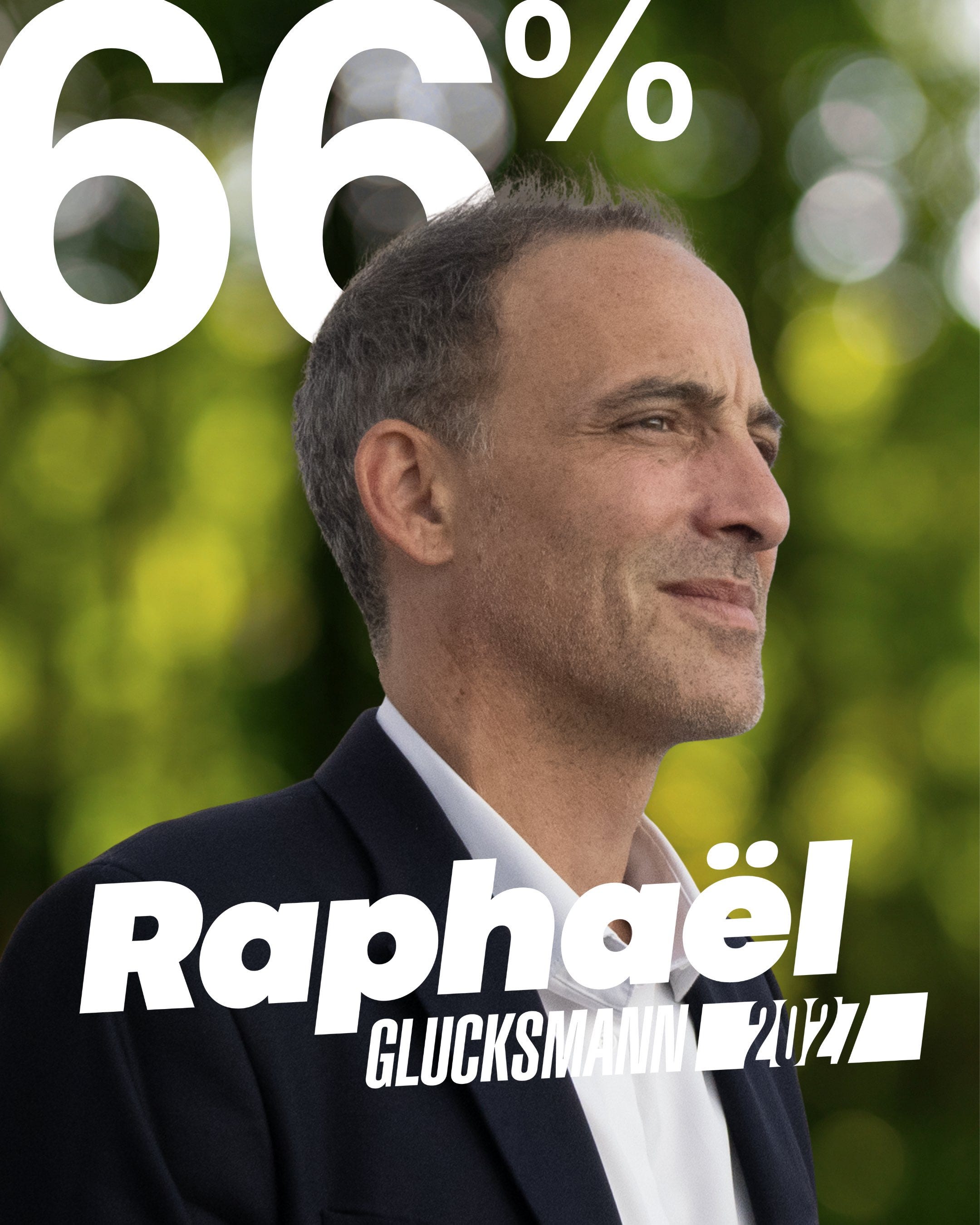
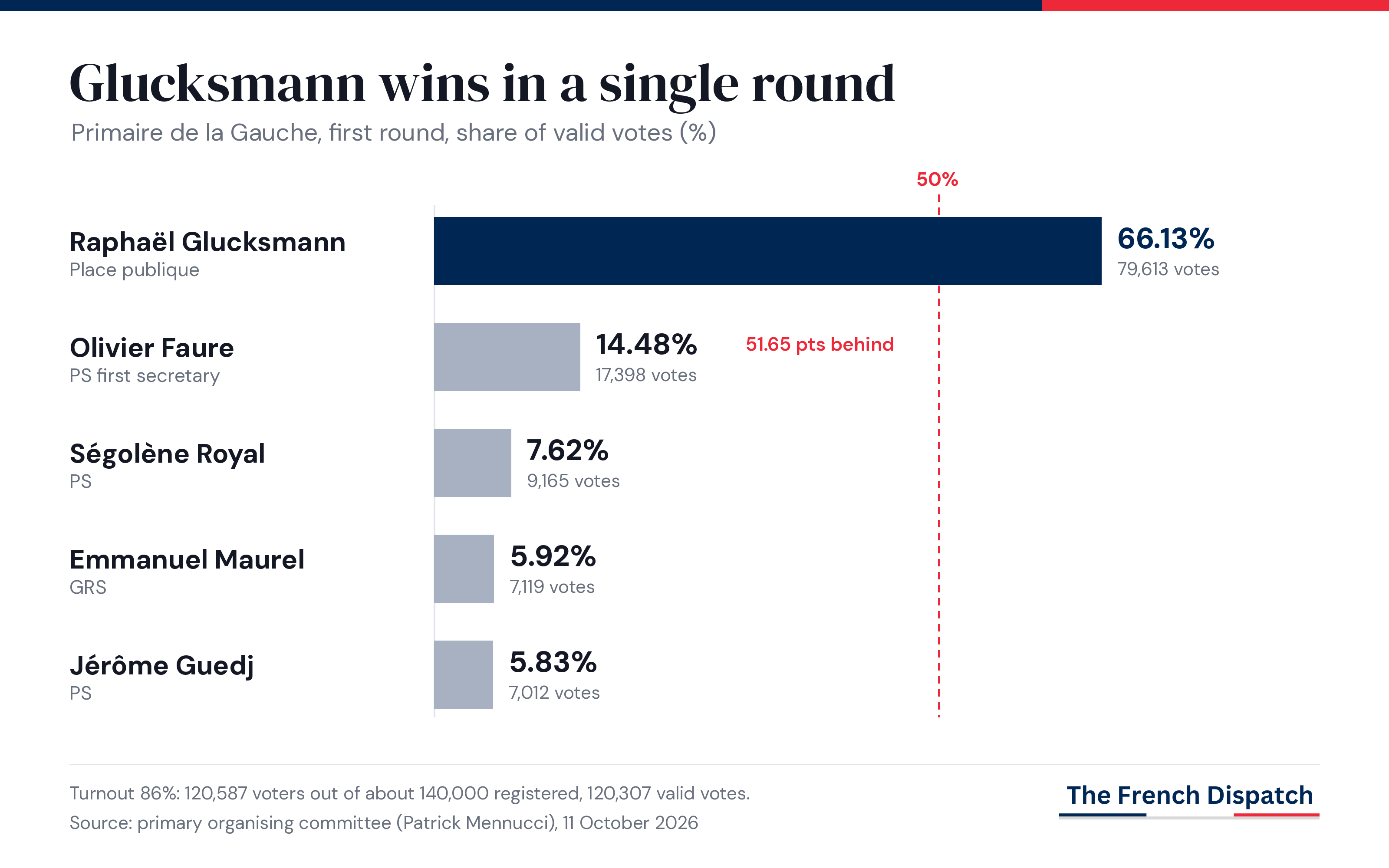
Raphaël Glucksmann will be the social-democratic candidate for the 2027 presidential election following his crushing victory in the left-wing primary today with 66.13% of valid votes.
The Place publique MEP won 79,613 votes, more than four times the tally of Olivier Faure, first secretary of the Socialist Party, who came second on 14.48%. Ségolène Royal finished third on 7.62%, ahead of Emmanuel Maurel (5.92%) and Jérôme Guedj (5.83%), and no second round will be needed.
A condemnation of the Nouveau Front Populaire
The campaign focused on Jean-Luc Mélenchon, who spent Sunday at a rally in Clermont-Ferrand. Glucksmann, with Guedj alongside him, accused Faure of drifting back towards La France insoumise, as Faure had done with the Nupes in 2022 and the Nouveau Front populaire in 2024.
Olivier Faure, for his part, said Glucksmann kept handing Mélenchon victory in absentia, and repeatedly revived the charge of macronisme against the MEP, pointing to the former Macron allies around him.
The two candidates who campaigned on a clean break with LFI took close to 72% between them, while the driving force behind both alliances finished below 15%. Guedj drew the same conclusion within minutes of the result, hailing a clean and decisive win that showed left-wing voters wanted no alliance with LFI.
That verdict needs a caveat about who delivered it. Socialist members voted by 55% in early July for a closed primary limited to the PS and allied organisations such as Place publique, rejecting Faure’s plan for an open vote among all left-wing sympathisers. Glucksmann had refused for months to enter any primary, and only declared in August, once the format suited him.
Glucksmann’s party, Place publique, nearly tripled its membership ahead of the vote, and registrations passed 140,000 against a forecast of 90,000. Part of the electorate that rejected Faure’s strategy was recruited for the purpose, so Sunday’s result measures the balance of the social-democratic camp more than the mood of PS members.
How the primaire worked
Voting was electronic only, and taking part cost €15.
A cyberattack launched as polls opened on Friday morning slowed the platform and forced organisers to extend voting until 18:00 on Sunday. Patrick Mennucci, who chaired the organising committee, described it as an attack on French democracy that went well beyond the primary. He put final participation at 120,587 out of roughly 140,000 registered, a turnout of about 86%, with 120,307 valid votes.
A first-round majority settled the contest outright. Three televised debates preceded the vote and sharpened the dividing line over LFI.
Even so, they drew criticism, with Glucksmann conceding that they had fallen short of the occasion.
Militant landslides travel badly
Big wins in Socialist nomination contests have not translated into a strong national performance in the PS’s recent history.
Benoît Hamon won the open primary in January 2017 with nearly 59% in the run-off against Manuel Valls, in front of up to two million voters, and then collapsed to 6.36% in the first round that April as Valls and much of the party’s right wing drifted towards Emmanuel Macron.
Anne Hidalgo took more than 72% of the PS members’ vote in October 2021 while polling between 4% and 7% nationally, and she delivered the worst presidential result in the Parti socialiste’s history, with 1.75% the following April.
Ségolène Royal, unaffectionately nicknamed “tata yoyo” by militants for her conspiratorial and hostile behaviour towards just about anyone and everything, won the 2006 members’ ballot with 60.7% in a single round before losing to Nicolas Sarkozy in the second round of the 2007 election.
Glucksmann starts from a stronger position than Hidalgo did, though hardly a commanding one: the latest Ifop poll, published on 30 September, had him fourth in the first round. He appears to know it, writing on Twitter that “this first place gives me no rights. Nothing is won.” The scale of the exercise points the same way: the open primaries that chose François Hollande in 2011 and Benoît Hamon in 2017 drew between 2.6 and 2.8 million and between 1.6 and 2 million voters respectively.


Political scientist Frédéric Sawicki had warned that a primary only works if the losers respect the result, citing Manuel Valls’s refusal to back Hamon in 2017, with a hint between the lines that this may have helped Emmanuel Macron to win.
However, most of Sunday’s losers settled that question quickly. Royal said she was very disappointed but promised to work for unity on the left with everything she had, and Maurel said the size of the win placed obligations on Glucksmann and on the rest of them collectively. Faure had not reacted publicly by the time this article was published. Former President François Hollande, who refused to stand and whose potential candidacy has been a spectre over the left, has been positioning himself since the summer to move if Glucksmann slides in the polls, and fourth place nationally gives him reason to keep that door open.
Royal also named a deeper problem: for the first time since the party was founded, she said, there is “no PS candidate as such”.
Glucksmann needs the Socialist Party to run his campaign, but the party still answers to Faure, who has now lost two votes on its direction in three months, first to his own members and then to a candidate from outside the party.
On the eve of the vote, Faure warned that a Glucksmann victory would mean the “effacement” of the PS from the presidential contest, perhaps confusing himself with the party. He must now put it at the service of the man he said would write it out of that contest.
Thank you for reading the French Dispatch! If you liked what you read, you should like this post and subscribe to the newsletter by clicking/tapping the button below:
And if you’d like to contribute a coffee or two to help fuel my coverage of the wild world of politics, feel free to click on the picture below:
